Turn Model Calls Into Reliable Agent Products
A reliable agent product is a model call wrapped in durable infrastructure: check memory, tools, identity, sandboxing, observability, and evals before you buy or build.
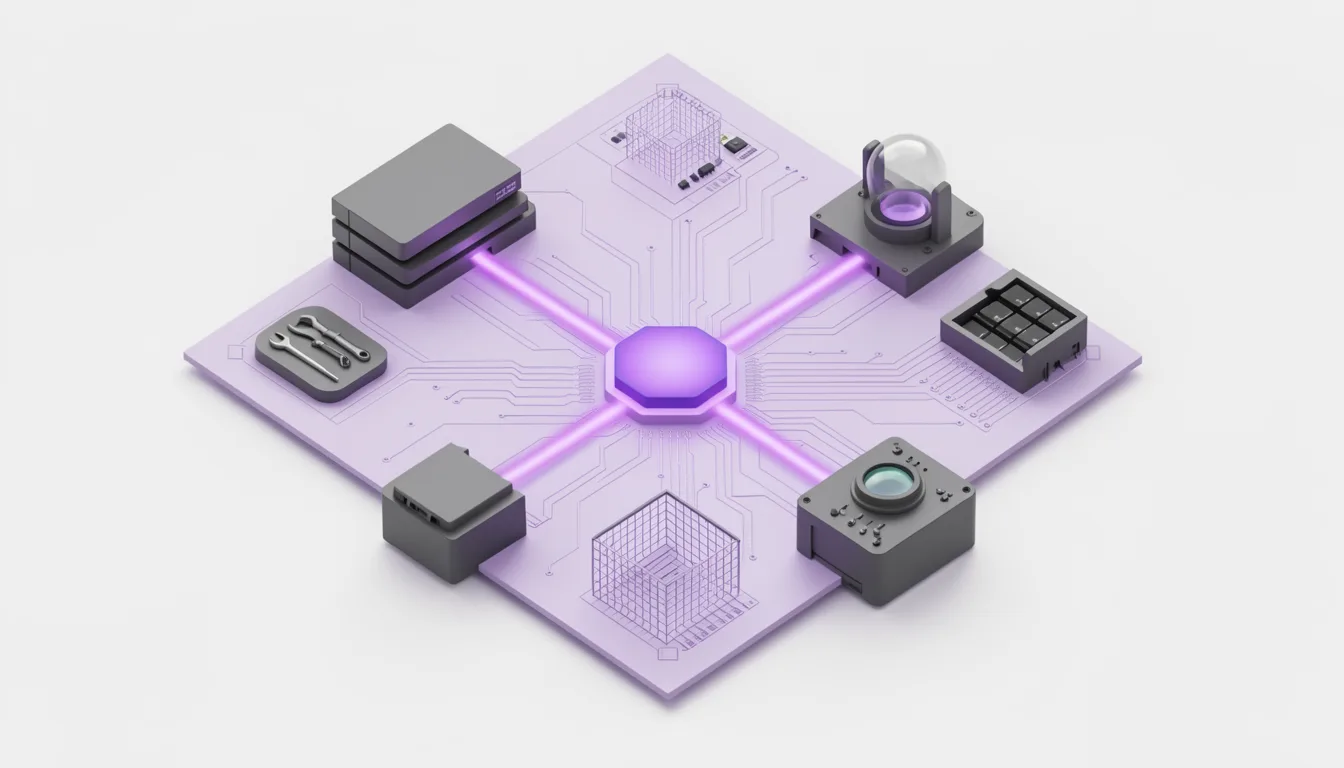
You are deciding whether to buy or build agent infrastructure. The trade-off is the infrastructure that makes a model callable at scale, not model quality. If one user action triggers one model call and a failed tool call forces two retries, the cost is three calls, not one.
In 2024, 60% of generative AI proof-of-concepts were dropped, largely because governance fell short. Those gaps show up as missing memory, weak tool contracts, unclear identity, unsafe sandboxing, missing observability, and unmeasured evals.
Broadcom, Citrix, CrowdStrike, ServiceNow, and Genesys converged on a three-layer AI agent infrastructure stack. Anthropic's Model Context Protocol, now hosted by the Linux Foundation, underpins the connectivity layer of the vendor stacks, with more than 97 million SDK downloads.
The model call is the easy part
A model call returns text. An agent product must return a completed action. That difference drives spend. Retries add model calls, permission checks add policy decisions, and tool results add state updates. If the stack cannot hold that state, the user sees a broken product even when the model is correct.
Production load is measurable. At Xperience 2026, Genesys announced a four-product agent stack in which Contextual Intelligence provides persistent enterprise memory and an AI Control Plane handles discovery, identity, and policy enforcement. AgentMinder can support peak loads of nearly 43 million API calls per day. B.AI's cumulative token volume was 8.19 trillion over a 15-day window, with more than 220,000 new API users. The stack must carry that load before a capacity problem becomes a customer complaint.
Six layers decide whether the agent ships
Use this checklist in a vendor demo or a build review. Each item is a test you can run before you commit. The metric is the thing you keep, not the feature name.
- Memory persistence: Give the agent a fact in one session, then ask for it in a new session after a restart; it should retrieve the fact.
- Tool contract: Run a tool call with a missing required field; it should return a typed error instead of guessing.
- Identity and policy: Create a user with no access to a tool, then ask the agent to call that tool; it should be denied before execution.
- Sandbox isolation: Give the agent a file path outside its workspace; it should not read or write there.
- Observability: Trace a request end to end; you should see model calls, tool calls, latency, and token spend.
- Eval pass rate: Run representative tasks; record pass or fail.
Memory fails first. An agent that forgets the user's goal will repeat work, ask redundant questions, and spend tokens on context it should already have. Persistent memory separates a demo from a workflow.
Tools fail second. A model can choose the right tool and still fail if the tool schema is ambiguous, the error is untyped, or the retry policy is missing. Tool contracts should behave like an API contract: inputs, outputs, errors, and timeouts are explicit.
Identity and policy are the governance layer. The model can do the task, but the organization cannot say who may do it, on which data, under which limits. A control plane is the production answer to that gap.
Sandboxing sets the execution limit. An agent that can read files, run code, or call external services needs a workspace with hard limits. Isolation keeps a bad prompt from becoming a data leak.
Observability is how you diagnose failures. VMware AI Factory includes built-in observability for token throughput, latency, compute, and memory utilization. For an agent product, the trace must show the model call, the tool call, the policy decision, and the final action. If you cannot replay a failure, you cannot fix it.
Evals set the release decision. A pass rate is the only number that tells you whether the agent can ship. It should cover representative tasks, edge cases, and refusal cases. If the pass rate drops after a model upgrade, the product should not go live until the regression is explained.
Cost follows the failure path
The cheapest model call is the one you do not make. Poor memory, weak tool contracts, and missing policy checks each add latency, tokens, and support load: the agent re-reads context, retries, or asks for permission after it has already started.
Buy the layer when the vendor can prove the metric. Build the layer when the metric is core to your product and the vendor cannot expose it. Put the metric in the contract, then run the checklist again after every model upgrade.